
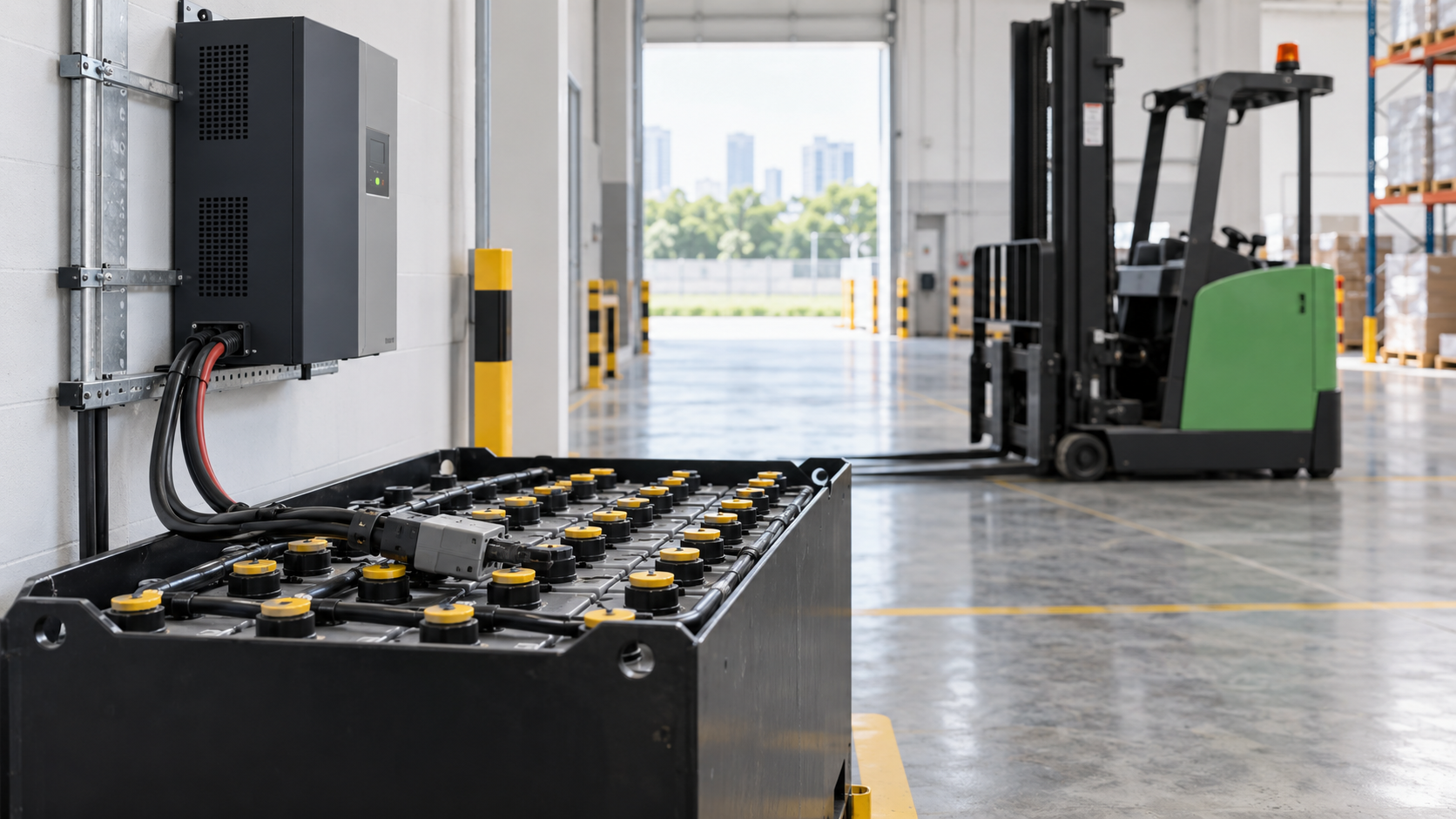
A traction battery is part of the operating system of an electric reach truck or forklift. Its condition, compatible charger, charging routine and maintenance practice affect daily availability and the life of the equipment.
This is a general guide for conventional flooded lead-acid traction batteries in Singapore. It is not a substitute for the battery, charger and truck manuals, or for your workplace’s approved safety procedures. Lithium-ion, sealed and other battery types require different care.
Confirm the battery type before maintenance
Do not assume every electric truck uses the same battery system. Conventional flooded lead-acid batteries may require water checks. Sealed, lithium-ion and other battery types have different maintenance and charging requirements.
Before anyone tops up water, changes a charger or follows a routine from another truck, identify the exact battery type and read the relevant manufacturer instructions. Battery maintenance should be performed only by trained and authorised personnel.
Match the charger to the battery and site
The charger should be matched to the actual battery—not selected by appearance, country of origin or a general rule. Confirm the battery voltage, capacity, chemistry, connector and required charging profile, then check the charger nameplate against those details.
For a Singapore warehouse, also confirm the available electrical supply and any installation requirements at the premises. Singapore sites may have 230 V single-phase or 400 V three-phase low-voltage supply, but the actual site arrangement and the charger input requirement must be checked before connection or installation work.
Allow the charging cycle to complete
A conventional lead-acid battery needs the charging routine specified for that battery and charger. A full cycle may take many hours, but the correct duration is not the same for every battery, charger or operating pattern.
Avoid treating an overnight window, an amp rating or a previous truck’s routine as a universal instruction. Follow the charge-complete indication and the approved procedure for the individual equipment. If the battery regularly fails to complete a charge or no longer lasts through the intended work, arrange an assessment.
Check water level after charging
For a conventional flooded lead-acid battery, inspect the electrolyte level after a full charge and add water only when needed, following the battery manufacturer’s stated level. Use the approved clean or distilled water source for the equipment.
Do not overfill. Adding water before charging can create overflow risk as the battery charges, except where the battery manual specifies an action to protect exposed plates. Keep the battery surface clean and report corrosion, leakage, damaged caps or unusual odour before further use.
Recharge before deep discharge
Avoid routinely running a conventional lead-acid battery until it is fully depleted. A planned charging routine helps reduce the risk of deep discharge and gives the team a predictable window for equipment availability.
The correct recharge point depends on the battery, charger and operation. Use the truck’s approved battery indication and your equipment provider’s instructions rather than applying one percentage to every truck. Do not keep operating a unit that has reached its approved low-charge limit.
Make battery care part of the daily check
- Confirm that the battery and charger are the intended matched pair for the unit.
- Check charging leads, connectors, plugs and cable routing for visible damage before use.
- Keep the charging area clear, clean and managed under your workplace safety procedure.
- Record reduced runtime, charge faults, warning indicators, heat, leakage or damage and report them promptly.
- Use model-specific battery removal or access procedures only where the truck manual and site training cover that exact unit.